
Framework sections
The framework / 04
Connections
The concepts describe different aspects of action. These connections show how they relate and where their meanings differ.
Models can be connected through common elements, such as people, actions, objectives, and means. For example, an action may be a means to an objective. These connections help show how a strategy works and what must be specified for its parts to work together. Sentence patterns and diagrams are tools to represent the models and make their connections explicit.
Strategy and plan
A strategy guides choices about how to pursue an objective. A plan sets out how someone proposes to proceed. A strategy may be carried out through one plan or several. Plans can change as circumstances develop while continuing to follow the same strategy.
Intention and purpose
An intention is what someone means to do. A purpose is what they seek to achieve by doing it. The same intended action may serve several purposes.
Example: A bank intends to expand lending to small businesses to reduce its dependence on home loans.
Someone intends to (a bank)
Purpose and objective
An objective identifies something to achieve. A purpose connects an action with the end it serves. The same end can have both roles. Achieving one objective may make another possible, with both serving a wider purpose.
Example: A hotel group’s purpose is to attract business travellers. Its first objective is to acquire a site near the airport. Achieving this allows it to pursue the next objective: opening a hotel there.
Both objectives serve this purpose
Objectives and means
The same objective can be pursued through different means. Choosing between them involves considering how each would work in the circumstances.
Example: An insurer aims to expand into a country where it does not yet operate. It could set up its own business there, buy a local insurer, or form a partnership with one.
Possible means
- or
- or
Means can be compatible or incompatible.
Select a means to highlight its connection to the objective. Select it again to show all means equally.
All three possible means are shown equally.
Information, appreciation, and the application of principles
Information refers to what is learned or reported about a situation. Appreciation involves describing the situation and weighing what matters in it. Application of principles brings relevant principles to bear on that understanding. Accurate information and sound principles can still lead to a poor plan if the situation is misunderstood or the principles are misapplied.
Example: A school wants to improve results by targeting academic support.
Action: Provide additional tuition in the subjects with zero marks.
Deliberation and planning
Deliberation involves weighing reasons for and against a course of action. In planning, we work out how to proceed. Developing a plan can reveal reasons to reconsider the course.
See an example
A department considers combining several application processes. Planning reveals that applicants would still need to supply the same information twice, prompting reconsideration of the proposal.
Decision, resolve, and execution
A decision determines what to do. Resolve is the determination to carry it through. Execution involves doing the work.
Example: A hotel group approves monthly stays. Its managers persist through a slow start, while staff change booking options and welcome monthly guests.
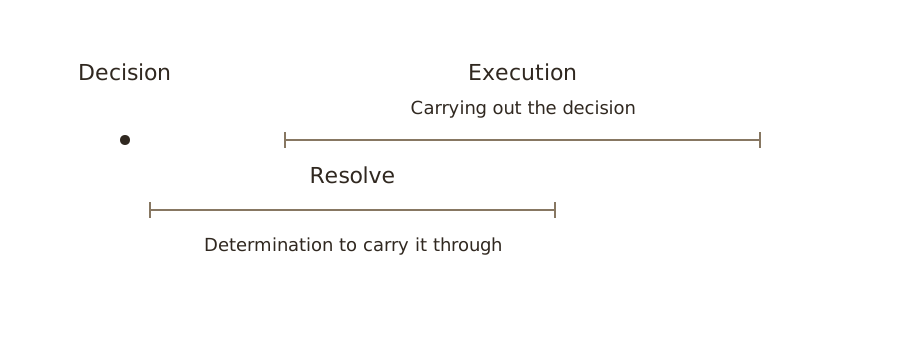
Resolve can continue into execution without necessarily lasting throughout it.
Intention, objectives, and results
What someone means to do, what they aim to achieve, and what their action brings about can differ. Completing the intended work may produce several results, including consequences that were anticipated but not desired.
Example: A university introduces online postgraduate courses as intended. It achieves its enrolment objective, while completion rates are lower than expected.
Intended or sought
What happened
Stages and phases
Stages distinguish kinds of work, such as gathering information, planning, and execution. Phases are successive parts of an undertaking. Several stages can occur within each phase. An objective can help identify when a phase is complete.
Example: A higher education provider trials a course at one campus before offering it elsewhere. The trial and expansion are phases, each involving planning and execution. An objective of the trial is to determine whether enrolments can cover delivery costs.
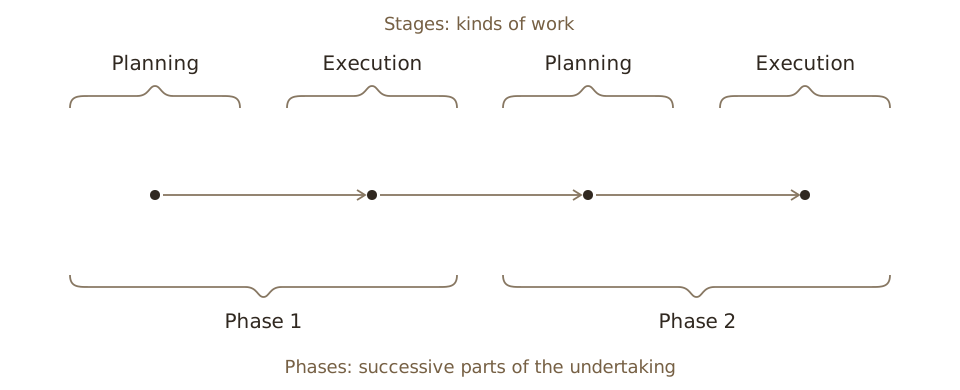
Stages can overlap and recur; they need not always follow this sequence.
Stretches and intention
A stretch refers to how much of what happens we include in an action description. An intention can connect several actions as parts of one undertaking. Looking at that whole can change how we understand a particular part.
Example: A charity temporarily suspends new referrals while training additional volunteers. The pause forms part of its intended expansion of support.
IntentionPause new referrals while training more volunteers, then reopen with a larger team.
Considered alone, pausing referrals could look like reducing support.
Plain Strategy, developed by Dr Julien Maréchal. © 2026 The Governance Practice.
Original materials:  CC BY 4.0. Source. Scope and attribution.
Logos, third-party material, and website software are excluded.